Does it need an API key?
No. The entire judging path — replay, tests, bench, chain verification — runs offline and keyless on FakeQwen, a deterministic fixture-backed transport. Live Qwen is an explicit opt-in: set DASHSCOPE_API_KEY and PERMAFROST_LIVE=1 and the identical command routes through real DashScope.
What happens when the network goes down?
The local reflex layer keeps firing alarms in under a millisecond with zero connectivity, events queue ECIES-sealed, and on reconnect the queue syncs into a gap-free hash chain. scripts/verify_offline.py proves it in CI by killing real sockets mid-replay.
What exactly is FakeQwen?
A deterministic, fixture-backed stand-in for the Qwen Cloud transport that lets every one of the 331 tests run offline and byte-reproducibly. The live transport (qwen3.7-plus, qwen3.6-flash, text-embedding-v4) is wired end-to-end — a bogus key drives a real DashScope round-trip and returns an authentic 401 with a real request_id, proving the endpoint is no stub.
Is the $60 hardware claim real?
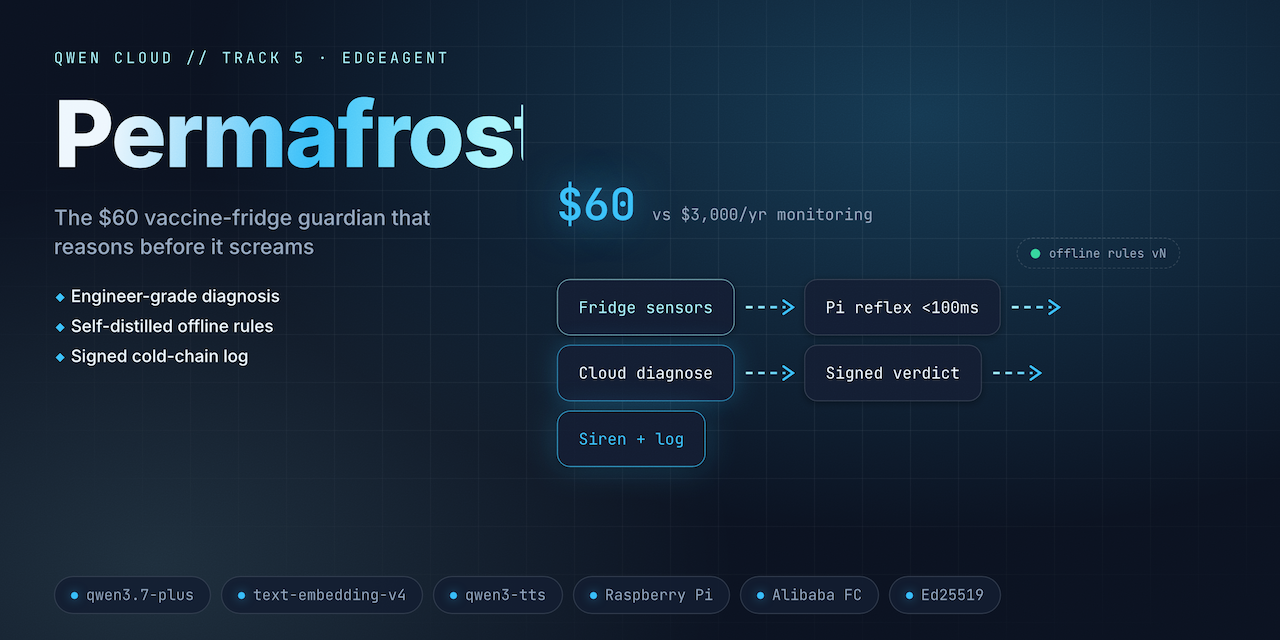
It's a bill of materials, not a shipped product: Raspberry Pi + 2× DS18B20 probes + reed switch + buzzer ≈ $60, versus $1–3k/yr commercial monitors. Honest caveat, straight from the README: no physical rig has run yet — replay mode drives the identical daemon from recorded curves and is the supported judging path.
Is the audit log really tamper-evident?
Yes, and it's tested: every entry extends a SHA-256 hash chain with Ed25519-signed daily Merkle roots. Invariant tests flip a single byte in an entry, hash, sequence number, or signed root and assert verify-chain fails and exits 1 — across all four seed curves, and gap-free through a simulated power cut (os._exit mid-replay).
How do I run it?
Python 3.12, three minutes, zero hardware: pip install -e ".[dev]" then permafrost replay --curve seeds/door_ajar.csv --db audit.db --fresh. Follow with permafrost verify-chain audit.db and pytest for the full 331-test suite. The complete judge script is in DEMO.md.
 PERMAFROST
TRACK 5 · EDGEAGENT
PERMAFROST
TRACK 5 · EDGEAGENT